Article content
We often imagine that great landscape photos happen instantly. You stand in an epic location, press the shutter, and the camera captures magic. The reality is different. Even in iconic locations like Iceland, the camera only captures raw data. It does not capture emotion. I want to show you the process behind a specific image from Vík. It involved freezing waves, a lucky moment with a bird, and a RAW file that initially looked completely lifeless.
The scene
The Location: The Black Sand Beach at Vík (Town Side). Unlike the famous Reynisfjara side, the view from the town offers a direct look at the Reynisdrangar stacks. They appear wider and more clustered from this angle, rising like massive walls from the ocean.
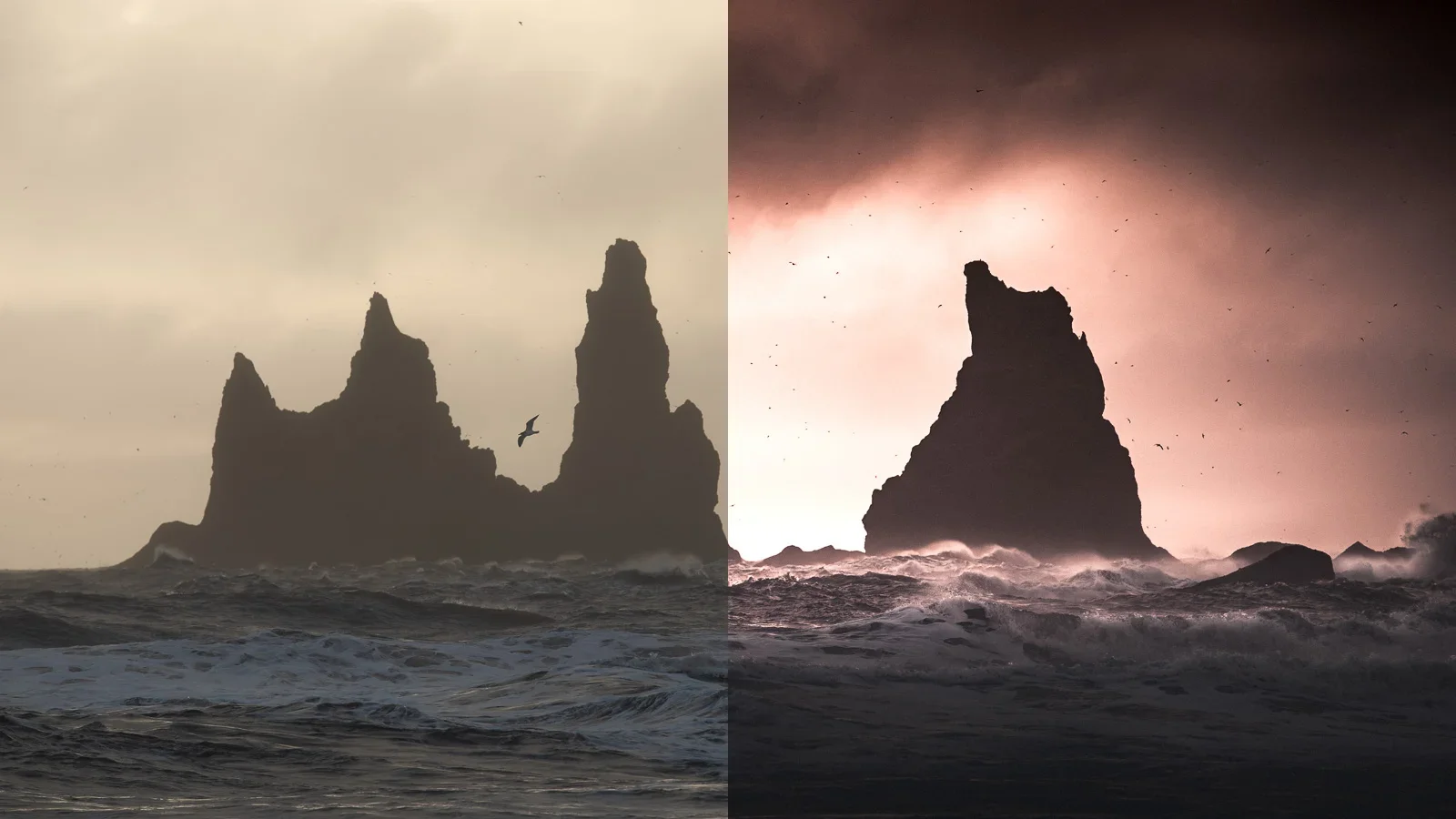
The Subject: The Reynisdrangar sea stacks and the relentless Atlantic waves. The conditions were deceiving. There was plenty of light, but it was flat. Low clouds acted like a giant softbox and killed the contrast. The scene felt powerful to the eye, but the camera saw only grey-yellow shapes against black sand. I wanted to capture the chaotic energy of the ocean crashing against the shore. The scene needed a focal point to give it scale.
The lucky moment
To emphasize the water textures and perspective I shot it low. I waited for the waves to crash and create patterns. Then luck happened. A fulmar flew right through the frame. I reacted instinctively and pressed the shutter. The bird was positioned perfectly between the background and in the middle of the sea stacks. It gave the image life.
Camera Settings:
Focal Length: 200mm
Aperture: f/5.6
ISO: 100
Shutter Speed: 1/640 sec (To freeze the bird)
The disappointing RAW file
When I opened the file on my computer, the drama was missing.
The low clouds had turned the scene into a wash of yellow-grey tones. This is the moment many photographers quit. They think they failed because the image does not look like the moment they remember. They are wrong. The data is there. It just needs to be sculpted.
The edit
Editing is not cheating. It is translation. I needed to translate the flat data back into the stormy reality I experienced.
1. Creating Separation The bird was the soul of the photo. I used a radial mask to create round light and increase the contrast around the bird. This separated the wings from the clouds even more.
2. Building the Atmosphere The flat light meant there were no deep shadows. I darkened the top part of the sky and the rocks to bring back their weight. This immediately made the waves and the bird pop out.
3. The Cinematic Grade The natural colors were too flat. To create the moody, ominous feeling of a storm, I needed a specific color palette. I shifted the white balance warmer to emphasize the mood. Then I applied a color grade that pushed deep, desaturated blue into the shadows and soft earth tones into the highlights.
This is a complex balance. To learn more about how I choose these specific tones, read my full guide on Cinematic Color Grading.
The story behind the moment
The roar of the Atlantic Ocean at Vík is something you feel in your chest. It is loud, chaotic, and deafening. I was focused on my camera settings, frustrated by the salt spray coating my lens. Then I stopped looking at the camera and looked at the scene. I watched the birds. They were tiny against the black cliffs, fighting a wind that was hard to even stand in. Yet, they flew with absolute precision. In that moment, the chaos faded. I realized the photo wasn't about the rocks. It was about life existing in a place that felt hostile to it. The contrast between the fragile bird and the immovable stone became the heart of the image.
This is why we edit. Not to fake reality, but to strip away the distractions until only that feeling remains.
The final result
The editing process transformed a snapshot into a story. The bird now looks like it is battling the elements. The rocks look ancient and imposing. This image proves that a flat RAW file is not a failure. It is a canvas. Don't delete your photos just because the light wasn't perfect. The drama is often hiding in the edit.
Recommended
Limited Edition Prints
Signed fine art prints from northern expeditions. Each image is a limited edition — signed, numbered, and made to be lived with.